
Do You Need an Enclosure for ABS and ASA? What Actually Changes
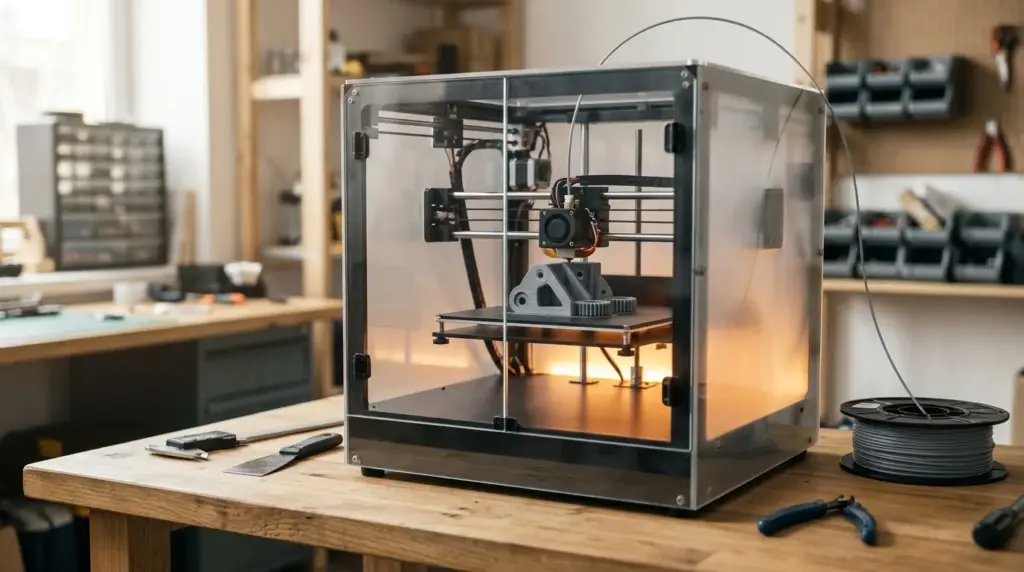
An open-frame printer can usually reach the nozzle temperature ABS and ASA need. That is why so many people are surprised when their first ABS print curls off the bed or splits in half halfway up. The problem is rarely the hotend. It is the air around the part. This guide explains what an enclosure actually does for ABS and ASA, when you can get away without one, and how to tell from a printer’s specifications whether it is a good match.
Why ABS and ASA behave differently from PLA
ABS and ASA are amorphous styrene-based plastics with a glass transition temperature of roughly 100 °C, compared with about 60 °C for PLA. They also shrink more as they cool. When a layer is laid down at 240–260 °C and the air around the print is at room temperature, the outside of the part cools and contracts much faster than the inside. That uneven shrinkage builds internal stress.
The stress shows up in two ways:
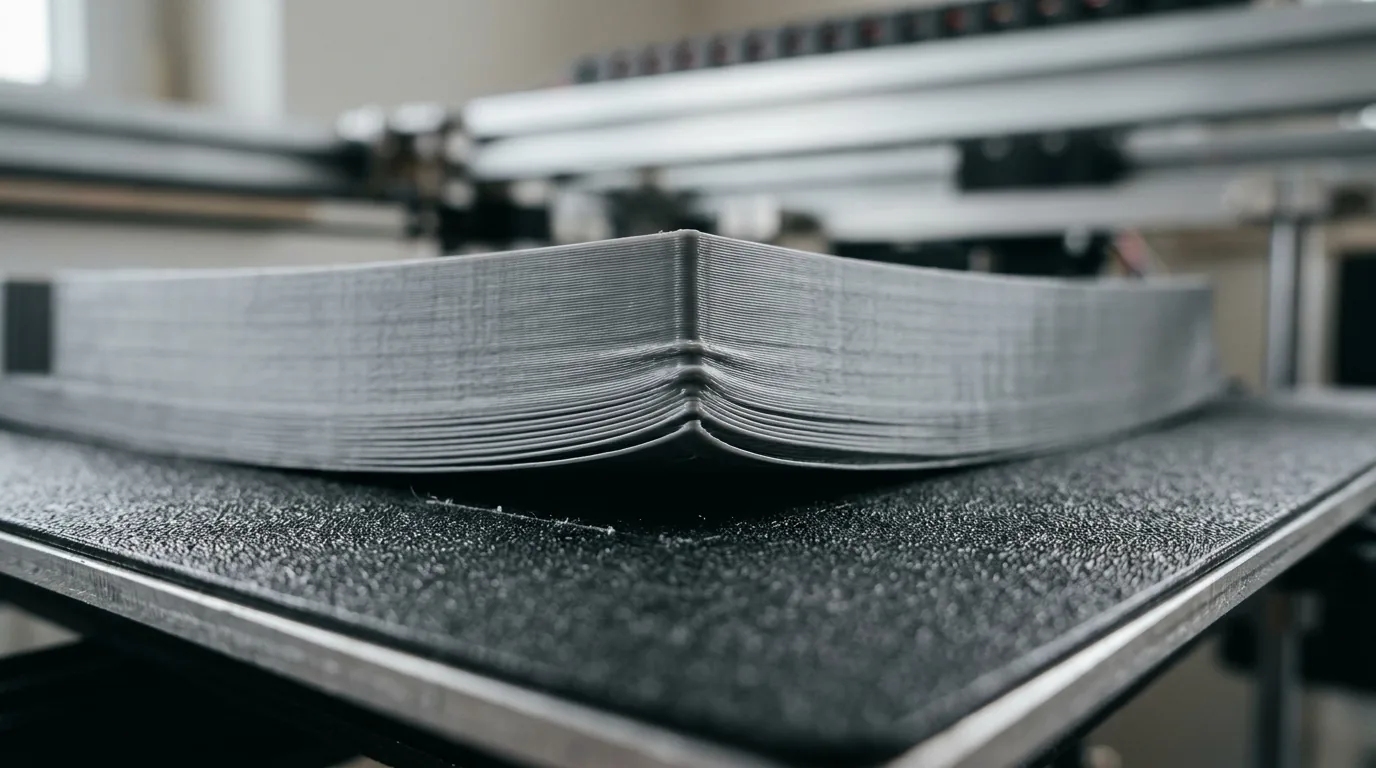
- Warping: corners lift off the build plate because the upper layers pull inward as they shrink.
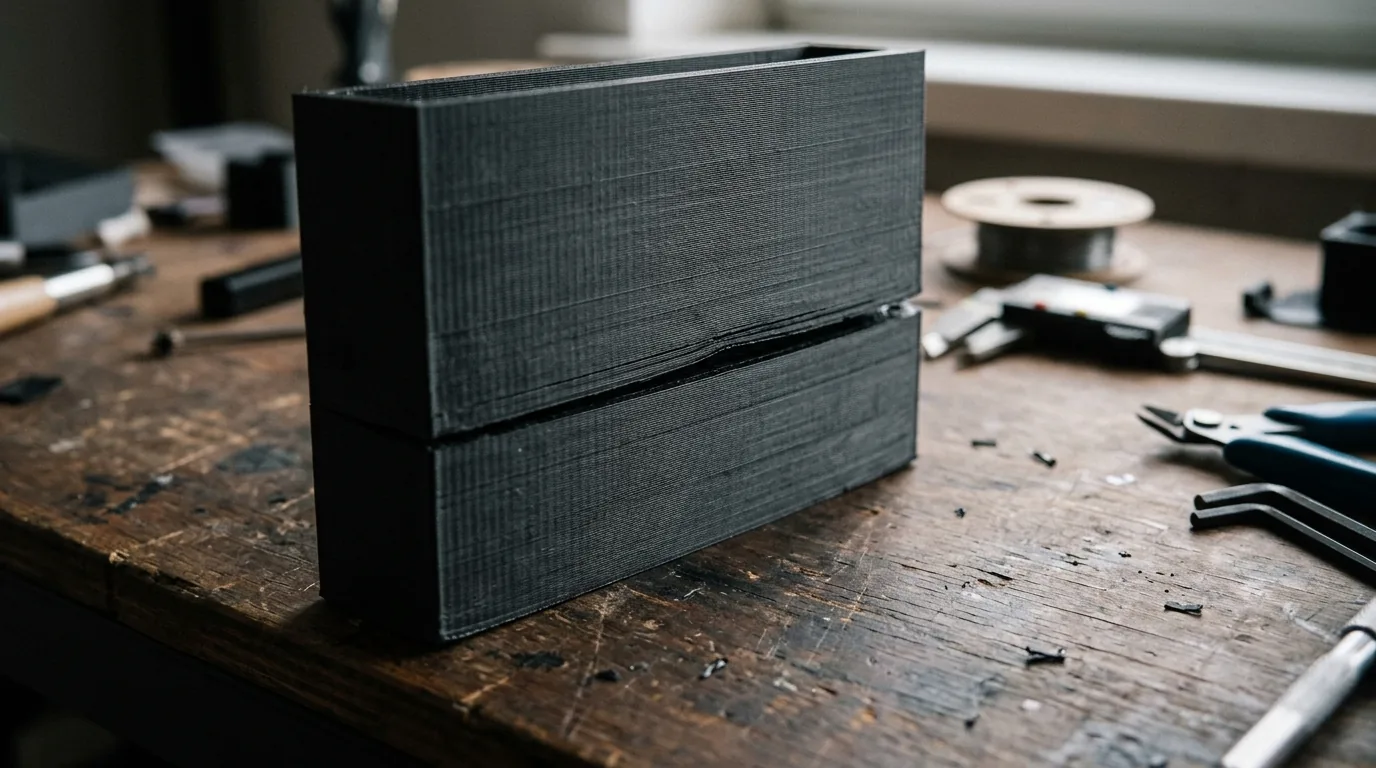
- Layer splitting (delamination): a cold draft cools a layer before the next one bonds properly, and the part cracks horizontally, often on tall, thin walls.
PLA shrinks far less and sets quickly, which is why it prints well on almost any machine. PETG sits in between: it benefits from stable air but rarely needs an enclosure.
What an enclosure really does
An enclosure does not heat the plastic directly. It does three simpler things:
- Keeps warm air around the part. The heated bed warms the air inside the chamber, so the temperature difference between fresh and older layers is smaller. Passive enclosures commonly settle somewhere around 35–50 °C during long ABS prints, depending on bed temperature and how well the box is sealed.
- Blocks drafts. Even a small air current from a window, a fan or someone walking past can cool one side of a part and start a crack.
- Contains fumes. ABS and ASA release styrene and ultrafine particles while printing. An enclosed printer with a filter, or an enclosure that vents outside, makes indoor printing more pleasant. It is not a substitute for ventilation.
Some newer machines go further with an actively heated chamber, which lets the chamber reach a set temperature independently of the bed. That matters more for polycarbonate and some nylons than for ABS, but it makes large ABS parts noticeably more reliable.
Can you print ABS without an enclosure?
Yes, within limits. Small, low parts with modest infill can print acceptably on an open-frame machine in a warm, draft-free room. The problems grow quickly with:
- parts taller than a few centimeters;
- large flat footprints, which warp at the corners;
- high infill and thick walls, which store more shrinkage stress;
- parts that must be strong across layers, such as brackets and clips.
That is exactly the pattern reflected in the database. The open-frame Bambu Lab A1 with ABS result is rated not recommended: the hotend and bed are suitable, but the open frame is the main limitation, and the recommendation is to limit use to small, low-infill models. The same printer with ASA runs into the same constraint.
Enclosed printers compared with open-frame printers
For the same material, the enclosure often decides the result more than any other specification. A few examples from the database:
| Printer | Frame | ABS result |
|---|---|---|
| Bambu Lab A1 | Open | See result |
| Bambu Lab P1S | Enclosed | See result |
| Prusa MK4S | Open (enclosure sold separately) | See result |
| Prusa CORE One+ | Enclosed | See result |
| Creality K1C | Enclosed | See result |
| QIDI Tech Q2 | Enclosed | See result |
Open each result to see the exact nozzle and bed limits, the main limitation and the official source that was checked.
How to check a printer before you buy ABS or ASA
Look for these items in the manufacturer’s specifications or manual:
- Enclosure: built in, optional accessory, or none.
- Maximum bed temperature: ABS and ASA generally want 90–110 °C on the bed. A bed limited to 80 °C makes first-layer adhesion harder.
- Maximum nozzle temperature: 260 °C or more gives headroom; most current printers meet this.
- Official material list: some manufacturers explicitly list ABS and ASA as supported or not recommended for a model. That statement carries more weight than a generic “supports engineering filaments”.
- Filtration: a carbon or HEPA filter is a comfort and air-quality feature, not a compatibility requirement, but it matters if the printer sits in a living space.
You can run this check in seconds with the compatibility checker, or browse every model on the printer database.
If you only have an open-frame printer
These steps reduce, but do not remove, the risk:
- Print in a warm room away from windows, air conditioning and fans.
- Turn the part-cooling fan off or very low for ABS and ASA, except for bridges and small overhangs.
- Use a brim on parts with sharp corners and clean the build plate so adhesion is consistent.
- Orient the part so the most stressed direction does not depend on layer adhesion.
- Consider a third-party or DIY enclosure, but check that it does not trap heat around electronics or a filament path the manufacturer did not design for higher temperatures.
- Ventilate the room, or vent the enclosure outdoors.
If your part does not need ABS’s heat resistance, PETG is often the more practical choice on an open-frame machine. Our PETG material page shows which printers handle it well.
ABS or ASA?
Both print in a similar way and need similar conditions. ASA is generally chosen for outdoor parts because it resists UV light and weathering better than ABS, which yellows and becomes brittle in sun. ASA tends to warp a little less, but not enough to change the enclosure answer. Compare the two on the ABS and ASA material pages.
The short answer
For anything beyond small test parts, ABS and ASA need an enclosed printer, or at least a well-designed enclosure and a warm, draft-free room. Check the enclosure, bed temperature and official material list together rather than looking only at nozzle temperature, and confirm the specific combination in the checker before buying a large spool. Material behavior is summarized in manufacturer guides such as the Prusa material guide.